
प्रस्तावना
Maurya Empire के गिरने के बाद भारत अचानक किसी अंधकार युग में नहीं गिरा।
Instead, the subcontinent witnessed a vibrant phase of regional kingdoms, cultural exchange, and political experimentation.
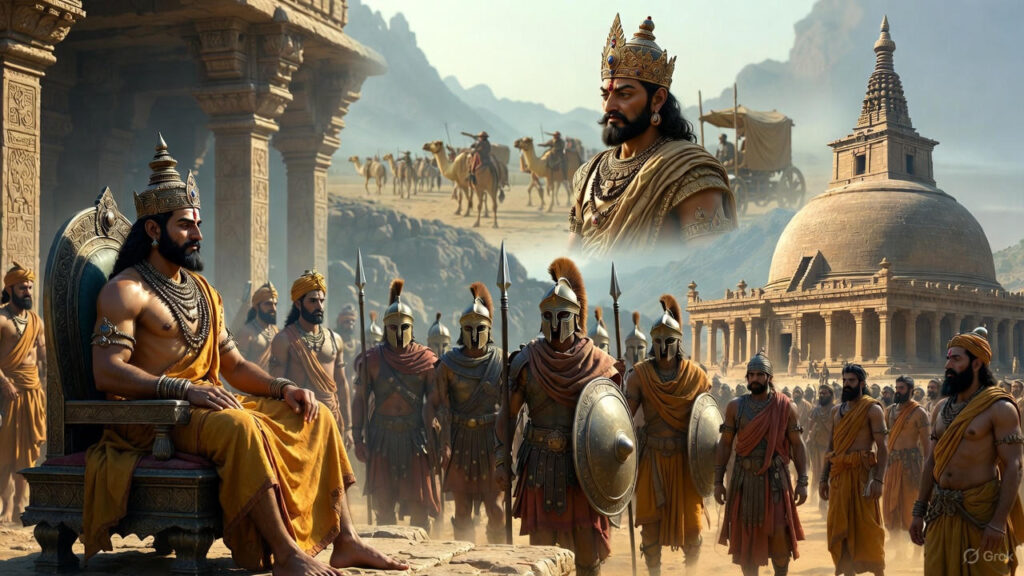
This period (185 BCE – 300 CE) is one of the most diverse and transformative phases of Indian history.
Trade grew, new art styles emerged, Buddhism spread across Asia, and India became a centre of global connectivity.
1. Sunga Empire — The Return of Brahmanical Power
Maurya Empire के अंतिम शासक Brihadratha की हत्या करके Pushyamitra Sunga ने नया साम्राज्य स्थापित किया।
Key points:
- Strengthening of Brahmanical traditions
- Revival of Sanskrit learning
- Patronage of art and architecture
- Expansion in central and north India
Sungas were never as powerful as the Mauryas, but उन्होंने गंगा के मैदानी क्षेत्रों में stability प्रदान की।
2. Indo-Greeks — Cultural Fusion in the Northwest
Alexander के उत्तराधिकारी ग्रीक rulers (Indo-Greeks) ने भारत के northwest क्षेत्रों पर शासन किया।
What they contributed:
- Fusion of Greek and Indian art (Gandhara School)
- Introduction of realistic human sculptures
- High-quality coinage with Greek and Kharosthi inscriptions
- Promotion of Buddhism
- Strong urban culture
Menander (Milinda) जैसे rulers ने Buddhism को intellectual support दिया.
3. Shakas and Parthians — New Powers in Western India
Central Asia से आए Shakas और Parthians ने western India में अपना control स्थापित किया।
Their impact:
- Boost to long-distance trade via Silk Route
- Strong coastal economy (Gujarat, Maharashtra)
- New coinage traditions
- Cultural blending of Iranian and Indian elements
They shaped western India’s commercial identity.
4. Kushan Empire — India’s Gateway to the World
Kushan rule (Kanishka के समय) इस पूरे काल का सबसे influential राजनीतिक और सांस्कृतिक phase है।
Why Kushans matter:
- Expansion from Central Asia to the Ganges
- Patronage of Buddhism (Kanishka = Second Ashoka)
- Gandhara and Mathura schools of art
- Silk Route trade का golden era
- Gold coins with exceptional artistry
- Emergence of new ideas, medical texts, and scientific exchange
Kushan Empire ने India को practically international power बनाया.
5. Satavahana Empire — The Power of the Deccan
Deccan plateau में Satavahanas, also known as Andhra dynasty, dominated for nearly 300 years.
Key highlights:
- Control of major trade routes connecting north and south
- Support for Vedic and Buddhist traditions
- Development of Prakrit language
- Construction of stupas, chaityas, viharas (Ajanta, Nasik, Karle)
- Strong navy and coastal trade
Satavahanas brought political unity to southern and central India.
6. Cultural and Economic Transformation
This period led to huge changes:
- Second Urbanisation (rise of cities again)
- Massive commercial activity via land and sea
- Spread of Buddhism to Central Asia, China, Southeast Asia
- Sanskrit, Prakrit literature expanded
- Art schools: Gandhara, Mathura, Amaravati
- Coinage became standard across regions
India became a hub of global culture, economy and religious thought.
7. Towards the Next Phase
By the 4th century CE, regional kingdoms stabilised and a new power emerged —
the Gupta Empire, which would take India into its classical golden age.
Conclusion
Post-Maurya period is often misunderstood as fragmented, but actually it was a period of innovation, artistic excellence, global trade and cultural flowering.
India opened itself to the world, absorbed influences, and exported ideas that shaped Asia for centuries.