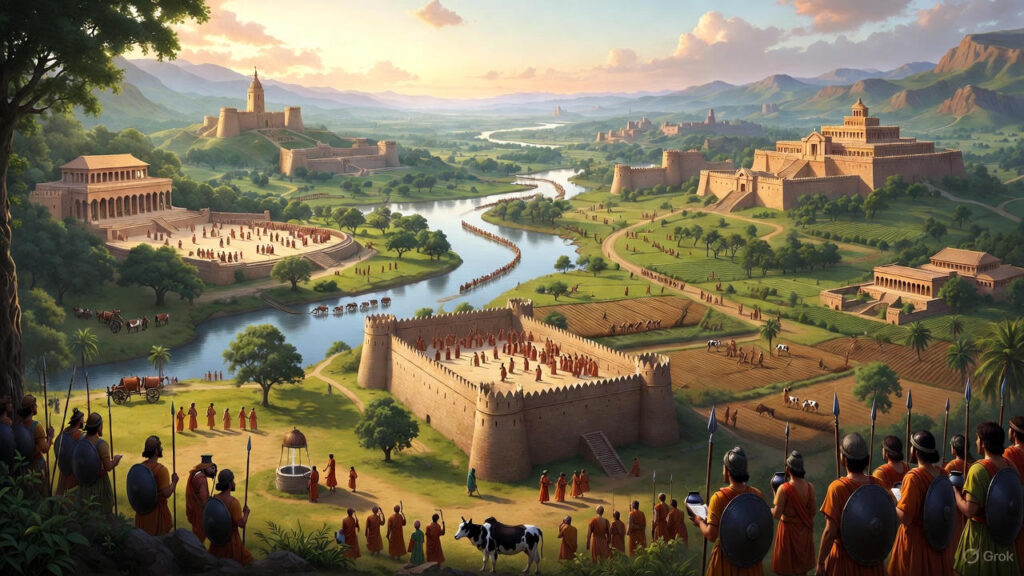

Mahajanapada Era (600–300 BCE) वह समय है जब भारत ने पहली बार tribal clans से organized political states की ओर कदम बढ़ाया।
This period marks the transition from Vedic tribes to structured kingdoms and republics — the real beginning of India’s political evolution.
🕰️ Background — जनपद से महाजनपद तक
Later Vedic society धीरे-धीरे विकसित हो चुकी थी:
- जनसंख्या बढ़ रही थी
- Agriculture फैल चुका था
- Iron tools ने productivity बढ़ा दी थी
- Settled life मजबूत हो रहा था
इस बदलाव ने छोटे-छोटे Janapadas को बड़े, संगठित Mahajanapadas में बदल दिया।
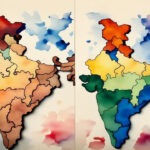
By 600 BCE, 16 major Mahajanapadas dominated the northern subcontinent.
🗺️ The Sixteen Mahajanapadas (संक्षिप्त + गहरा विवरण)
These kingdoms are mentioned in ancient Buddhist and Jain texts.
1. Magadha (मगध)
Capital: Rajagriha → Pataliputra
यह सबसे शक्तिशाली राज्य था।
Magadha later became the backbone of the Mauryan Empire.
2. Kosala (कोसल)
Capital: Ayodhya
A culturally strong rival of Magadha.
3. Vatsa (वत्स)
Capital: Kaushambi
Known forcommerce, art culture, and trade routes.
4. Avanti (अवंती)
Capital: Ujjain
A major western political and economic powerhouse.
5. Kuru (कुरु)
Capital: Indraprastha / Hastinapur
Highly organized administration and Vedic traditions.
6. Panchala (पांचाल)
Famous for education + military strength.
7. Vajji Confederacy (वज्जि संघ)
Capital: Vaishali
India’s earliest republican system (ganatantra).
8. Malla (मल्ल)
Capital: Kushinagar
Another republican polical culture.
9. Gandhara (गंधार)
Capital: Takshashila
Home to the world-famous Takshashila University.
…and remaining Mahajanapadas:
Anga, Chedi, Surasena, Matsya, Kamboja, Ashmaka, Kalinga.
⚔️ Monarchy + Republics — भारत की प्राचीन राजनीतिक विविधता
अधिकतर राज्य monarchies थे, लेकिन कुछ ganatantras भी थे —
Vajji, Licchavi, Shakya, Malla आदि republic-style governance को follow कर रहे थे।
These early republics had:
- councils
- debates
- collective decision-making
- voting traditions
This proves one thing:
India’s democratic roots are older than many ancient civilizations.
🌱 Economic & Urban Transformation
This period witnessed rapid progress:
→ Agriculture Expansion (कृषि क्रांति)
Ganga plains became highly productive.
→ Iron Technology
Iron ploughs and tools transformed farming and warfare.
→ Second Urbanisation
Cities like Ujjain, Kaushambi, Pataliputra emerged as major urban centres.
→ Trade Guilds (श्रेणियाँ)
Professional guilds of merchants and artisans governed trade —
similar to modern business associations.
→ Trade Routes
Uttarapath & Dakshinapath connected the Indian subcontinent.
📜 Religious & Intellectual Evolution
600–300 BCE is also an age of spiritual revolution:
- Buddhism (Gautama Buddha)
- Jainism (Mahavira)
- Upanishadic philosophy
- Shramana movements
- Early rationalist thought (Charvaka/Lokayata)
This era created the base for India’s future intellectual depth.
👑 Why Magadha Became the Superpower
Magadha’s rise was not accidental. It had:
- Fertile agricultural land
- Iron ore deposits
- Strong standing army
- Smart marriage alliances
- Strategic trade control
- Powerful rulers like Bimbisara & Ajatashatru
Magadha systematically defeated other Mahajanapadas.
This paved the path for the next great chapter:
👉 Episode 5 — Maurya Empire: Chandragupta to Ashoka
🧩 Short Summary (Hindi + English mix)
- 600 BCE तक भारत में 16 बड़े Mahajanapadas उभर चुके थे।
- Some were monarchies; some were republics.
- Economic growth, iron tools, agriculture, and trade boomed.
- Buddhism & Jainism emerged.
- Magadha became the dominant political force.
- This era laid the foundation for India’s first pan-Indian empire.