
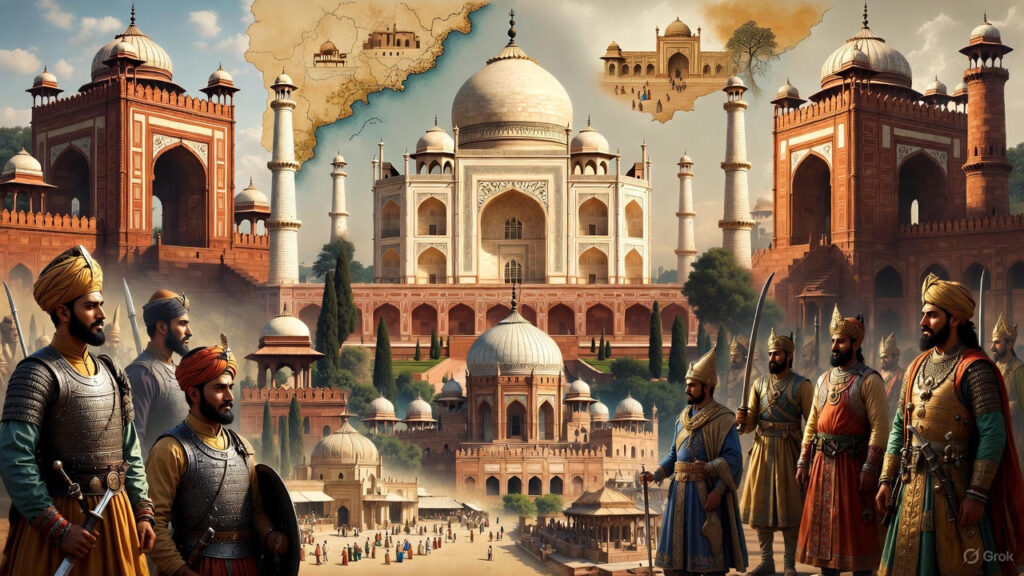

India’s Most Influential Medieval Empire — Rise, Expansion, Culture & Decline (Extra-Elaborated Edition)
Mughal Empire India के इतिहास का वह अध्याय है जहाँ politics, art, architecture, culture, military power और administration—इन सबका fusion अपने peak पर दिखाई देता है।
यह सिर्फ एक dynasty नहीं थी, यह Indian subcontinent की identity shaping powerhouse थी।
Mughal period ने एक ऐसा cultural and administrative framework develop किया जिसे बाद में British और फिर Independent India दोनों ने adopt किया—सीधे या indirectly।
1) The Rise of the Mughals — Babur’s Entry & Foundation (1526–1530)
Central Asia से आए Babur ने जब India में कदम रखा, तब Delhi Sultanate weakened हो चुकी थी।
Major Battles:
• First Battle of Panipat (1526) → Ibrahim Lodi defeated
• Battle of Khanwa (1527) → Rana Sanga defeated
• Battle of Ghaghra (1529)
Babur ने पहली बार India में gunpowder artillery को effective तरीके से इस्तेमाल किया—यह medieval Indian warfare का turning point था।
Babur’s Personality:
• एक warrior भी, एक poet भी
• Baburnama में nature, people, politics और battles का rare insight मिलता है
उनकी early death के बावजूद उन्होंने Mughal rule की मजबूत foundation leave की।
2) Humayun — Struggles, Exile & Return to Power (1530–1556)
Humayun का काल एक political drama है—rise, fall और comeback की कहानी।
Challenges faced:
• अफगान chiefs का rebellion
• Sher Shah Suri की lightning military tactics
• Delhi और Agra का loss
Sher Shah Suri के rule (1540–1545) ने administration को modernize किया, especially land revenue reforms, जो बाद में Mughals ने adopt किए।
Humayun’s Return (1555):
Persian support लेकर Humayun ने empire वापस पाया, लेकिन उनकी sudden death ने empire एक young prince (Akbar) को सौंप दिया।
3) Akbar the Great (1556–1605) — The Architect of a Pan-Indian Empire
Akbar ने Mughal Empire को सिर्फ बड़ा नहीं किया—उन्होंने इसे stable, inclusive और administratively powerful बनाया।
Administrative Innovations:
• Mansabdari system (rank-based military-bureaucratic structure)
• Dahshala revenue system (developed by Todar Mal)
• Centralized administration with provincial divisions
Political Strategy:
• Rajput alliances through diplomacy & marriage
• Expansion into Gujarat, Bengal, Kashmir, Kabul & Deccan
Religious Policies:
• Sulh-i-Kul (universal tolerance)
• Ibadat Khana debates
• Ek serious attempt at intellectual pluralism
Cultural Impact:
• Persian art + Indian themes = Mughal painting
• Music reforms under Tansen
• Literature, architecture, historiography का महत्त्वपूर्ण विकास
Akbar ने Mughal Empire को एक multi-cultural Indian power बना दिया।
4) Jahangir (1605–1627) — The Emperor Who Loved Art & Justice
Jahangir अपने artistic taste, realism in paintings और justice ideology के लिए याद किए जाते हैं।
Strengths:
• Nature-focused miniature paintings
• Mughal-European diplomatic & trade relations का expansion
• Political stability
Weakness:
• Growing influence of Nur Jahan
• Internal court politics
Jahangir का era art and aesthetics का एक अलग ही golden chapter है।
5) Shah Jahan (1628–1658) — The Crown of Mughal Architecture
Shah Jahan का reign “Golden Age of Mughal Architecture” कहलाता है।
Architectural Marvels:
• Taj Mahal
• Red Fort (Shahjahanabad)
• Jama Masjid (Delhi)
• Shalimar Gardens
• Peacock Throne
Urban planning, symmetry, white marble aesthetics — सब अपने peak पर।
Political & Economic Stability:
• Trade networks strong
• Revenue system organized
• Empire wealthy and globally admired
लेकिन इसी era में princes के बीच power struggle seeds बो दिए गए।
6) Aurangzeb (1658–1707) — Expansion, Orthodoxy & The Beginning of Decline
Aurangzeb ने empire को सबसे ज्यादा territory तक expand किया—South India तक Mughal power पहुँची।
Strengths:
• Strong military commander
• Administrative discipline
• Expansionist vision
Factors Leading to Decline:
• Deccan wars (30 साल) – economy drained
• Maratha rise under Shivaji
• Revolts: Sikhs, Jats, Satnamis, Rajputs
• Religious policy controversies
• Over-centralization
Aurangzeb के बाद empire united empire कम और fragmented political map ज्यादा लगने लगा।
7) Later Mughals (1707–1857) — Fragmentation, Foreign Invasions & British Control
Aurangzeb के बाद Mughal Empire rapidly collapse होने लगा।
Major Factors of Decline:
• Weak successors
• Regional powers का rise:
– Marathas
– Mysore
– Awadh
– Bengal
– Hyderabad
• Nadir Shah (1739) — Delhi sack
• Abdali attacks
• East India Company का steady rise
By mid-19th century, Mughals became symbolic rulers under British influence.
Bahadur Shah Zafar — last emperor, 1857 के बाद exile.
CULTURAL LEGACY — What the Mughals Left Behind
Mughal Empire की सबसे बड़ी पहचान उनकी cultural legacy है।
Contributions:
• Indo-Persian architecture
• Miniature paintings
• Development of Urdu
• Classical music traditions (Dhrupad, Khayal)
• Literature (Persian chronicles, poetry, translations)
• Garden architecture (Charbagh)
• Administrative systems adopted by modern India
• Blending of Indian & Persian culture
आज भी India का एक बड़ा हिस्सा Mughal cultural footprint carry करता है।
Conclusion
Mughal Empire power का history नहीं—
यह art, imagination, diplomacy, multiculturalism, administration और human creativity का history है।
India की modern identity में Mughal era का contribution गहरा, विविध और स्थायी है।